


Can Strabismus Correcting Glasses (Squint Glasses) Truly "Cure" Strabismus? In-Depth Analysis of 3 Popular Methods

scroll down
scroll down
Strabismus (or squint) is a condition where the two eyes are misaligned and do not look at the same point. This is not only a cosmetic issue but also seriously affects depth perception (stereoscopic vision) and quality of life. In the search for solutions, many parents and patients are advised about various strabismus correcting glasses, leading people to believe that wearing glasses is the simplest and most effective method to "cure" the condition.
However, can these glasses truly provide a complete cure, or are they just temporary supportive tools? Through an in-depth analysis of the three most popular strabismus correcting glasses methods, we will clarify their true role and what the core solution for restoring binocular vision is.
In reality, according to Vision Restoration specialists, strabismus correcting glasses only serve as a supportive tool to help the eyes see clearer or reduce diplopia (double vision), but they cannot independently rebuild the skill of visual coordination between the two eyes—the fundamental factor causing strabismus.
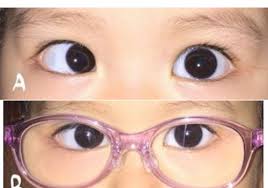
Methods using glasses to intervene with strabismus are generally divided into three main types, each operating based on a different optical principle, but all having their own limitations in achieving a complete cure.
Operating Principle: This method fundamentally involves correcting refractive errors (myopia, hyperopia) using prescription lenses. The goal is to help each eye see objects optimally.
Rationale: When one eye has a refractive error and sees blurry, the brain tends to ignore the image from that eye, causing an imbalance in coordination and leading to strabismus. Wearing myopic/hyperopic glasses helps restore clear vision, thereby enabling the brain to control both eyes to focus on one point.
Important Limitations:
Only applicable to those with refractive errors: This method is completely ineffective for people with strabismus who do not have myopia or hyperopia.
Does not build binocular vision skills: Wearing myopic/hyperopic glasses only solves the problem of seeing clearly, not the problem of coordination between the two eyes. Many cases without myopia/hyperopia still have strabismus, proving that strabismus is a neuro-muscular coordination issue, not just a lens power issue. Glasses only support clear vision but are not the solution for curing strabismus.

Operating Principle: Prism glasses work based on the phenomenon of light refraction.
Support Mechanism: When the eye is misaligned (exotropia or esotropia), the image does not fall correctly onto the macula center of the eye. The prism glasses bend the light ray from the object, adjusting the light's path so it falls correctly onto the macula, even though the eye itself remains misaligned.
Benefits: Prism glasses can help strabismus patients (especially those with stable strabismus with no potential for recovery) avoid the phenomenon of diplopia (double vision)—a very uncomfortable and dangerous problem.
Important Limitations:
Only an "optical trick": Fundamentally, prism glasses do not "correct" the eye's position or train the eye muscles. They only adjust the path of light. Wearing prism glasses means accepting that the eye is still misaligned, but the image is still perceived clearly.
No therapeutic function: This is a tool to support vision and reduce diplopia, not a method to help the eyes align naturally.
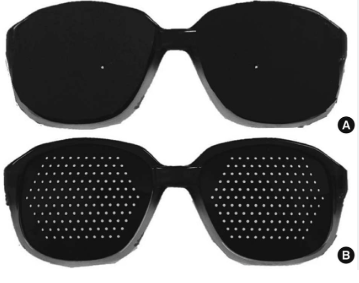
Operating Principle:
Pinhole Glasses: Most of the lens area is black, with only a small hole in the center. The wearer is forced to look through this hole.
Multifocal Glasses: The peripheral area of the lens has very high refractive power causing blurriness, and only the optical center (center) is clear.
"Training" Mechanism: Both types of glasses aim to create a mandatory clear viewing zone. If the eye is deviated (e.g., turned outward), the patient will find it difficult to see in that area and will be forced to adjust the eye muscles to bring their gaze into the clear optical center of the lens.
Limitations and Major Risks:
Restricted Vision: These glasses restrict the field of view, especially when looking at distant objects.
Risk of Amblyopia (Lazy Eye): Restricting the field of view during the development of vision can lead to another dangerous phenomenon called amblyopia (lazy eye). Amblyopia is a serious consequence, sometimes even harder to treat than strabismus. Therefore, this method is rarely encouraged by doctors.
In summary, all three strabismus correcting glasses methods only solve superficial problems (clear vision, reduced diplopia, creating a mandatory clear viewing zone) without addressing the root cause of strabismus: The coordination ability between the eyes and the brain.
Strabismus is a problem with the neuro-muscular system that controls the alignment and focus of the two eyes. To "cure" strabismus sustainably, the solution cannot just be wearing an optical aid.
Binocular Vision Training (Vision Therapy/Training) is the most effective and in-depth method for treating strabismus.
Goal: To train the brain and eye muscles to work together as a team, rebuilding the binocular visual reflex (binocular fusion).
Mechanism: Through specialized exercises, under the guidance of a specialist, the patient learns how to:
Focus (Accommodation).
Converge and Diverge.
Simultaneously accept and blend the two images from both eyes into a single 3D image.
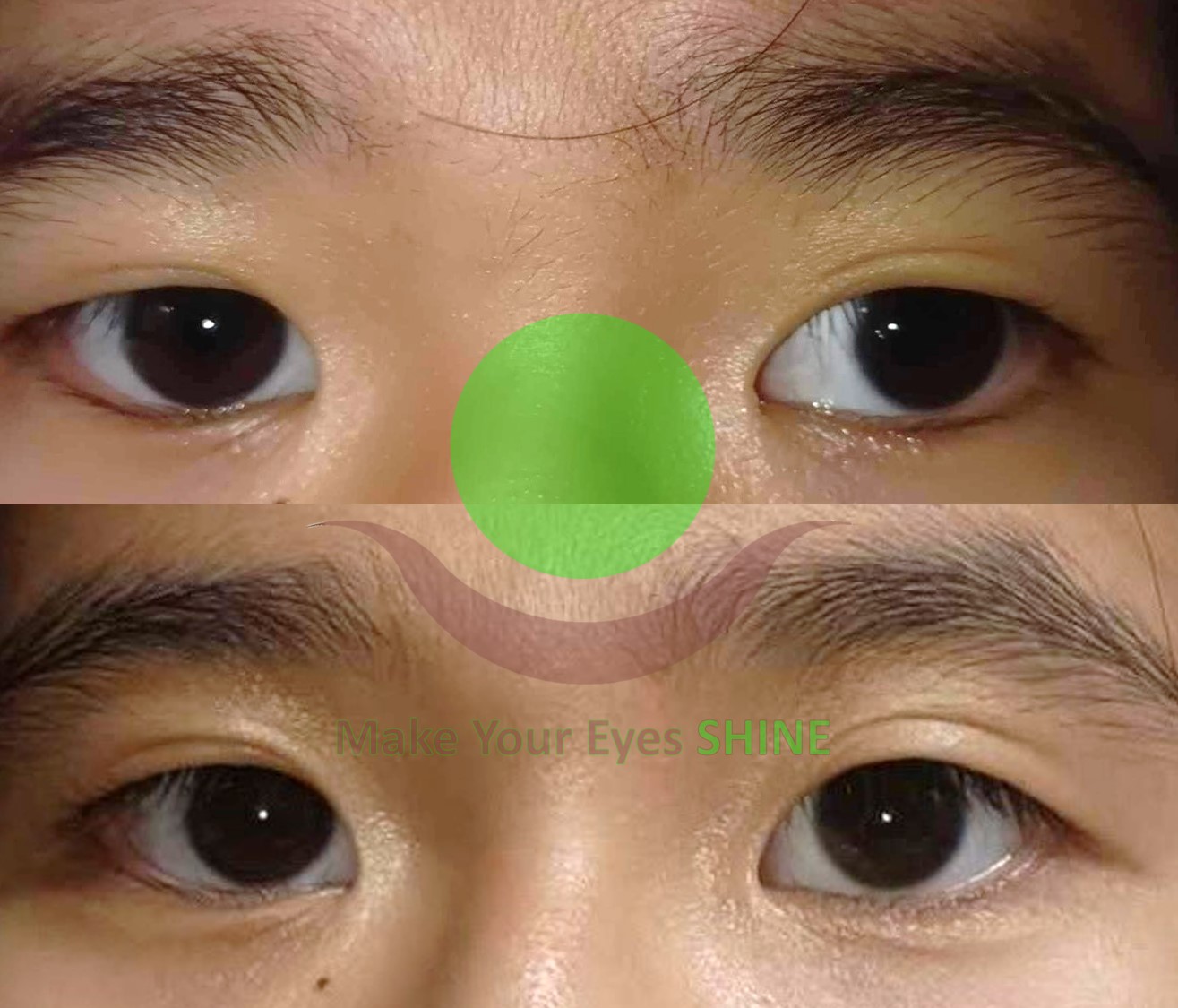 (People with strabismus (squint) can easily control both eyes to look straight at an object after training)
This is a process of re-educating the visual system, helping the eyes self-correct to align naturally and sustainably without relying on glasses. This method is particularly effective for strabismus that does not require surgery and residual strabismus after surgery.
Strabismus correcting glasses are an essential supportive tool in many cases, especially refractive correction glasses for clear vision and prism glasses for reducing diplopia. However, they are not the solution to cure strabismus completely. Only wearing glasses while neglecting core vision training will not yield long-term results and may even lead to the risk of amblyopia.
If you or a family member is experiencing strabismus, do not stop at just wearing glasses. Seek Vision Restoration specialists for an accurate diagnosis of the type of strabismus and to develop a personalized Binocular Vision Training protocol. This is the optimal path to restore natural alignment, develop stereoscopic vision, and sustainably improve the quality of life.

Write a comment
Các trường bắt buộc được đánh dấu *